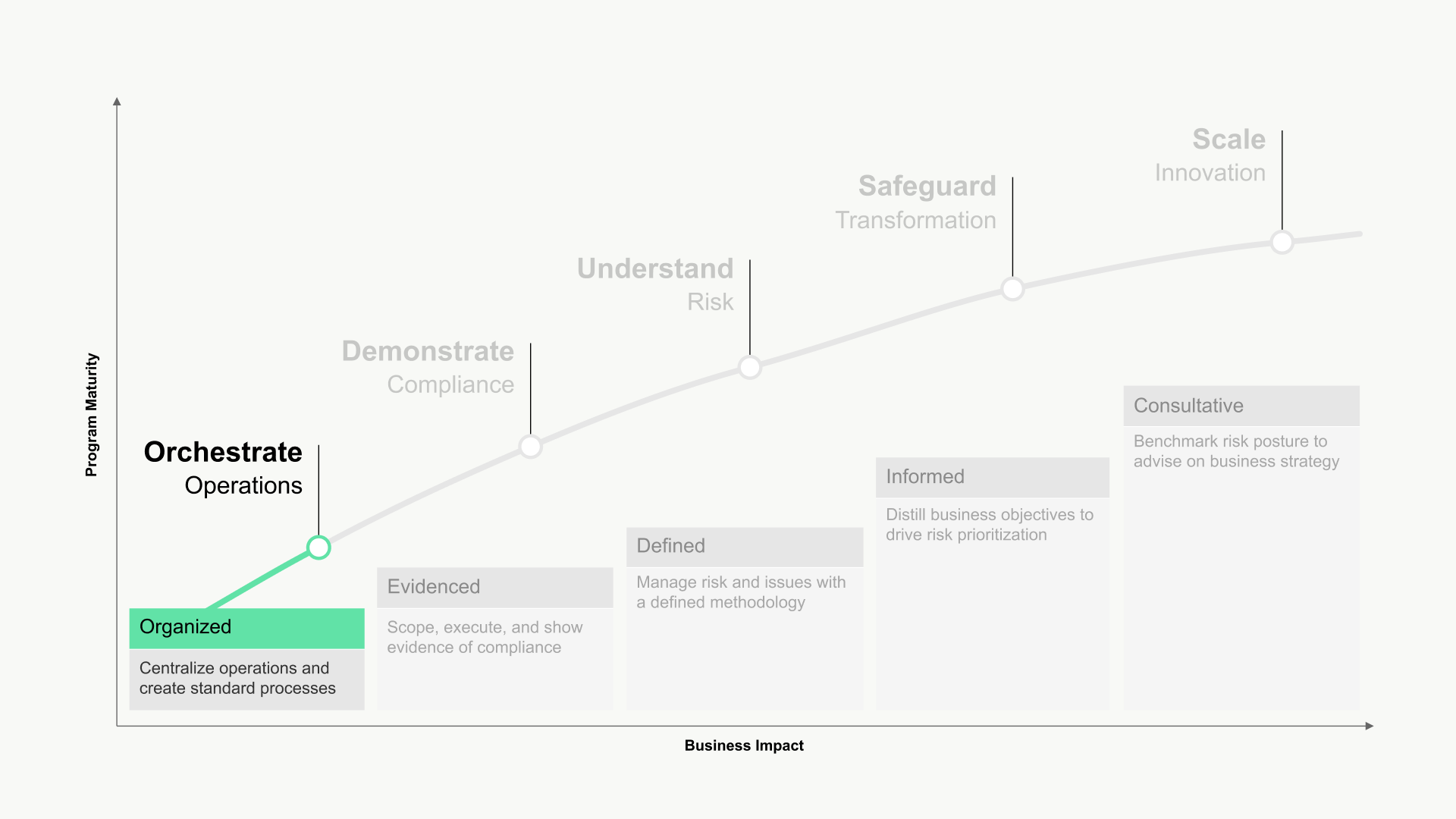
Where to Start: A Reliable Operating Model
Orchestrating operations means centralizing risk and compliance activity around repeatable day-to-day processes.
Fragmented programs create friction. A third-party request may move through one process, and a technology assessment may follow another. Compliance teams may gather evidence for the same control several times, while different teams can end up reviewing the same activity without sharing enough context.
The result? More work without a clearer view of risk.
A modern operating model brings these activities together. Workstreams should connect where they share information or ownership. Regulatory requirements should be mapped against common controls. Inventories should show how assets and systems relate to third parties and AI use cases. They should also connect those records to business processes. Workflows should make ownership and status visible.
Consistent processes also produce more consistent outcomes. That makes risk information easier for the business to trust and use.
This does more than improve efficiency. Consistent processes also produce more consistent outcomes. That makes risk information easier for the business to trust and use.
A Single Point of Entry for Risk Activity
A strong foundation also needs a simpler way for work to enter the risk program.
Organizations may receive requests through forms, portals, email, procurement processes, or security tools. Entry points can vary, but the process behind it should still create a consistent experience.
Every request needs enough context to determine what happens next. Ownership must be clear and routing should reflect the expertise required. Status needs to be visible to the people involved.
This creates a more predictable operating pattern. It also reduces the need to build a new workflow every time a new request appears.
Centralization doesn’t always mean replacing every specialized system. Some teams will still need purpose-built tools. The important step is establishing a central source of truth so the organization can connect the work and understand the larger risk picture.
Connect Requirements, Inventories, and Workflows
The next step is building shared context across the program.
Most organizations manage several regulatory requirements and industry frameworks. What often goes missing is that many of those requirements overlap. Treating each framework as a separate exercise creates duplicate controls and leads to repeated evidence collection and unnecessary work.
Cross-mapping requirements helps teams reuse controls and evidence where appropriate. The same principle applies to inventories. A technology asset shouldn’t exist as an isolated record when it supports a business process or comes from a third party. The same is true when it enables an AI use case.
Treating each framework as a separate exercise creates duplicate controls and leads to repeated evidence collection and unnecessary work.
Those relationships give risk teams the context needed to understand impact. They also prepare the organization for later maturity stages where risk must be aggregated and connected to business objectives.
Crawl, Walk, Run to Improve the Program
Modernizing risk operations is not an overnight transformation.
A practical starting point is to spend the first 30 days mapping how work moves today. Document intake paths and owners. Identify key handoffs and adjacent business processes. Use that map to find the activities creating the most friction.
Then choose one recurring workflow and improve it. Third-party intake is often a useful candidate because it touches several teams. Standardize the process and connect it to the broader system of record.
By the 90-day mark, the goal should be a repeatable improvement cadence. Teams should be able to see what changed and what they own. They should also know where the next source of friction sits.
That mindset is central to risk maturity.
The Foundation for What Comes Next
Orchestrating operations is only the first stage, but it supports everything that follows.
Each of the following stages in the maturity model requires stronger insight and more business context. That becomes difficult when workflows remain disconnected or ownership is unclear.
Modern risk programs need a dependable operating foundation first. Centralized work, connected context, and repeatable processes create that foundation. From there, risk teams can spend less time managing program mechanics and more time helping the business make better decisions.
Learn more about building the foundation in this on-demand webinar. Register for the remaining webinars in this series to explore how organizations can turn requirements into actionable work, automate execution, track progress, and produce defensible evidence at scale.