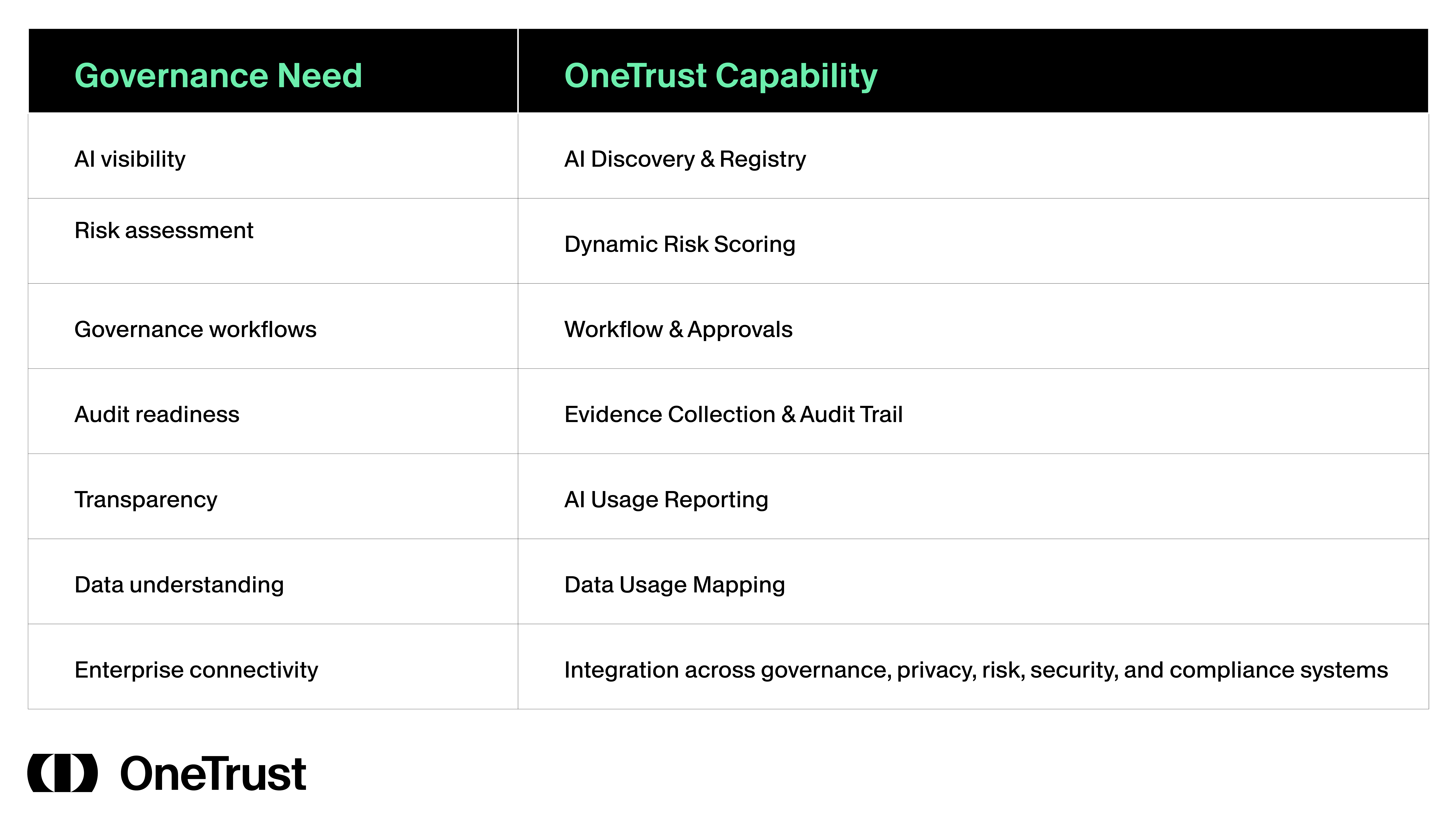
Together, these capabilities help organizations move from understanding AI risk to actively governing it.
Turning Governance Into Action
Many organizations understand their AI risks but struggle to put governance decisions into practice.
Effective governance requires more than identifying risk. It requires a repeatable way to assess, review, approve, and manage AI systems as they move through the organization.
This is where governance workflows become critical.
OneTrust's Workflow and Approvals capabilities help organizations establish structured processes that support stakeholder collaboration, reviews, attestations, and approvals.
As AI initiatives scale, organizations need repeatable workflows that embed governance into existing operating models without creating unnecessary friction.
The ability to demonstrate governance is equally important.
Evidence Collection and Audit Trail capabilities help organizations maintain comprehensive records of AI-related decisions, testing activities, assessments, and remediation efforts.
Regulatory expectations continue to increase globally, and enterprises need reliable documentation that can support internal governance requirements, audits, and regulatory inquiries.
Together, these capabilities help organizations establish accountability while enabling teams to move forward with confidence.
Building Trust Through Visibility and Reporting
Trust in AI depends on transparency.
Business leaders, risk teams, compliance professionals, and regulators all need visibility into how AI systems are being used, how they're performing, and whether they're operating within established guardrails.
OneTrust's AI Usage Reporting and Data Usage Mapping capabilities help organizations gain that visibility across their AI programs.
Reporting helps organizations understand adoption trends, monitor AI activity, and communicate governance outcomes to stakeholders throughout the business.
Data usage mapping extends that visibility by helping organizations understand how data flows through AI systems, where it originates, and how it's being used.
These capabilities become increasingly important as enterprises navigate evolving regulatory requirements and seek to demonstrate responsible AI practices.
Governance Workflows That Drive Accountability
One of the strengths highlighted in Gartner's assessment was OneTrust's ability to support end-to-end governance workflows spanning intake, risk assessment, approvals, and runtime enforcement.
This is increasingly important as organizations move beyond documentation-based governance, because policies alone don't reduce risk.
Organizations need governance decisions to translate into measurable controls, repeatable processes, and enforceable outcomes.
By connecting governance activities across the AI lifecycle, organizations can move from isolated reviews to operationalized governance that scales with AI adoption.
Inventory and Runtime Controls Built for an Agent-First World
AI systems are becoming more autonomous, distributed, and interconnected.
As AI agents become embedded throughout business processes, governance must evolve beyond static reviews and periodic assessments.
Organizations need continuous visibility, ongoing monitoring, policy enforcement, and evidence generation — because this is where the market is heading.
Governance must move closer to where AI operates, enabling organizations to continuously understand, govern, and enforce policies across increasingly dynamic AI environments.
Enabling Governance Across the Enterprise
AI governance cannot exist in isolation.
It must connect with broader privacy, risk, security, compliance, and data governance programs.
AI governance works best when it connects with the systems teams already use every day. Organizations rely on diverse technology environments, and governance platforms must help teams share information, streamline processes, and create a consistent governance framework across the organization.
This becomes even more important as enterprises deploy AI agents and autonomous systems that operate across multiple platforms and business processes.
Governance Should Help Organizations Move Faster
For many organizations, governance has traditionally been viewed as a checkpoint that slows innovation.
AI changes that equation.
The organizations seeing the most success with AI are building governance directly into how AI is developed, deployed, and monitored. When teams have visibility into risk, clear decision-making processes, and controls that operate where AI is used, they can move forward with greater confidence.
Effective governance is no longer about saying "no." It is about helping organizations say "yes" safely, consistently, and at scale.
In other words, governance should not slow innovation. It should help enable it.
Looking Ahead
AI will define the next decade of business. Governance will help determine who succeeds.
The launch of Gartner's first Magic Quadrant for AI Governance Platforms signals something larger than the arrival of a new technology category.
It signals that AI governance is becoming a strategic business capability.
As AI adoption accelerates, organizations need governance capabilities that provide visibility, accountability, operational efficiency, and measurable business value.
We believe OneTrust's recognition as a Visionary reflects the strength of a connected approach that helps organizations understand their AI estate, assess risk continuously, put governance decisions into practice, demonstrate compliance, and measure outcomes.
AI has changed how organizations operate. Governance must evolve from point-in-time reviews to continuous oversight, from documentation to enforcement, and from gatekeeping to enablement.
We believe AI-Ready Governance is the next evolution of governance: helping organizations move from periodic oversight to continuous visibility, scalable governance processes, and enforceable controls across AI and the broader technology ecosystem.
Frequently Asked Questions